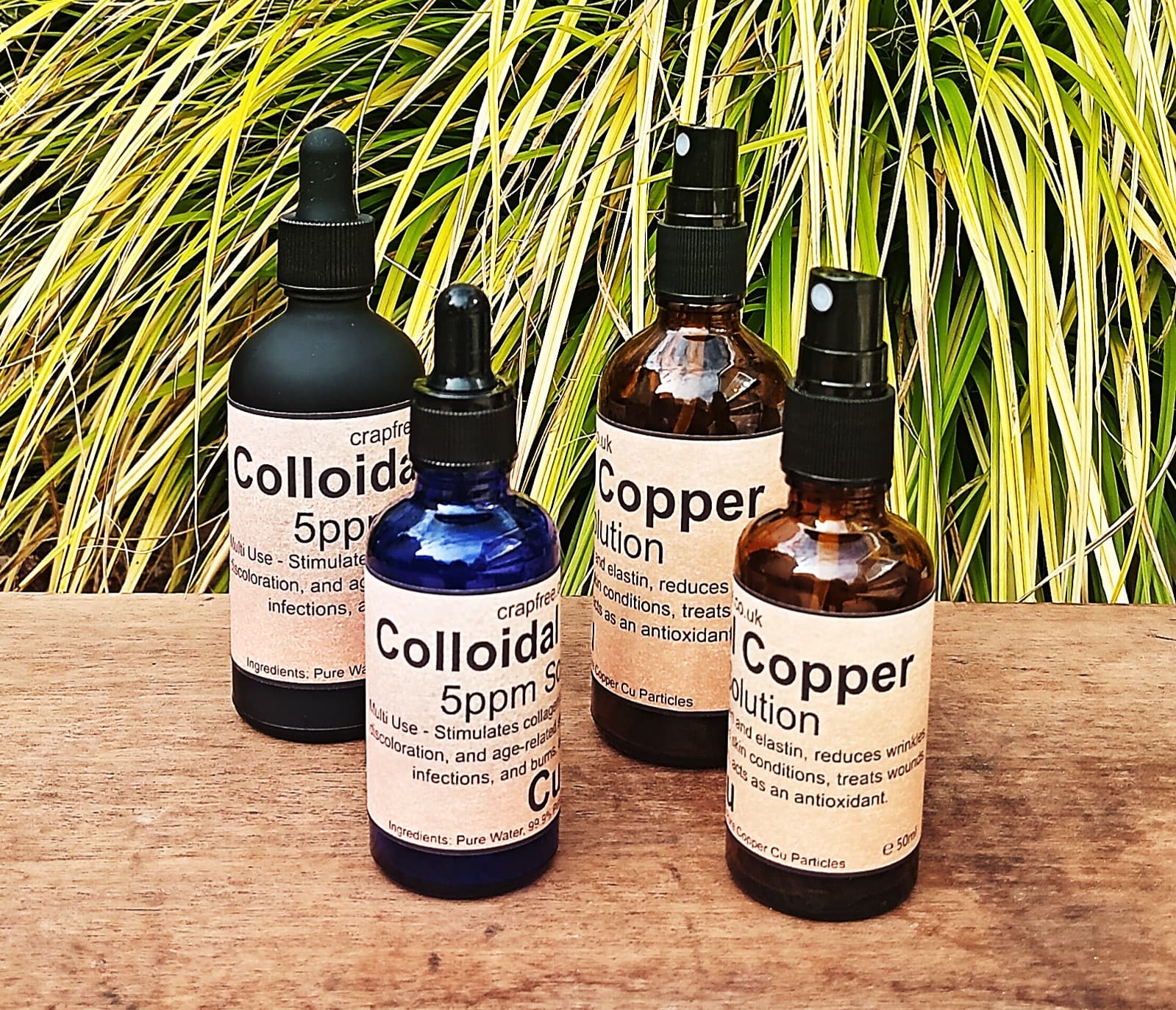
Colloidal Copper 5ppm
Colloidal Copper Disinfectant.
Many studies suggest that it can be effective against a wide range of pathogens, including bacteria, viruses, and fungi (See Below).
Many people claim copper helps support their immune health, fight off pesky germs, and keeps them feeling tip-top. We at crapfree produce and sell colloidal copper strictly as a disinfectant only and so cannot advise internal use of colloidal copper and customers do so at their own risk.
Colloidal copper has garnered attention in the realm of alternative health and wellness. It's basically tiny copper particles suspended in a pure distilled water, and it's been used for ages for its supposed health benefits. Parts Per Million (ppm) is a fancy term for saying how much of something is in a solution. In the case of crapfree colloidal copper it’s 5ppm, it means there are 5 parts of copper for every million parts of the liquid.
Copper as a disinfectant studies and further authoritative information:
A 2021 study "Copper as an antimicrobial agent: recent advances", it states:
"Copper nanoparticles. In a study where E. coli ATCC 15224 was exposed to increasing concentrations of 12 nm CuNPs, the authors reported a progressive inhibition of bacterial growth with increasing concentration".
A 2010 study "Metallic Copper as an Antimicrobial Surface" stated that:
"Bacteria, yeasts, and viruses are rapidly killed on metallic copper surfaces, and the term “contact killing” has been coined for this process. While the phenomenon was already known in ancient times, it is currently receiving renewed attention. This is due to the potential use of copper as an antibacterial material in health care settings. Contact killing was observed to take place at a rate of at least 7 to 8 logs per hour, and no live microorganisms were generally recovered from copper surfaces after prolonged incubation. The antimicrobial activity of copper and copper alloys is now well established, and copper has recently been registered at the U.S. Environmental Protection Agency as the first solid antimicrobial material".
A study in the American Journal of Infection Control Volume 54, Issue 8, August 2026, Pages 866-872 titled "Copper (Cu) for Reducing Environmental Healthcare Associated Infections (CuRE HAI): A 10-year pragmatic copper surface implementation study" concluded that:
"The CuRE HAI study suggests that implementation of novel copper components in a patient care environment may prevent HAIs. The continuous antimicrobial and antisporicidal activity provided by the copper surfaces likely explains at least some of the observed decline in HAI rates".
"In 1852 Victor Burq discovered that those working with copper had far fewer deaths to cholera than anyone else, and did extensive research confirming this. In 1867 he presented his findings to the French Academies of Science and Medicine, informing them that putting copper on the skin was effective at preventing someone from getting cholera".
"The oligodynamic effect was discovered in 1893 as a toxic effect of metal ions on living cells, algae, molds, spores, fungi, viruses, prokaryotic, and eukaryotic microorganisms, even in relatively low concentrations. This antimicrobial effect is shown by ions of copper as well as mercury, silver, iron, lead, zinc, bismuth, gold, and aluminium".
For more information on the potential benefits and uses of colloidal silver, read our "Benefits and Uses of Colloidal Copper" blog.
50 & 100ml glass bottle, 20ppm, Glass Pipette or plastic sprayer.
Product Information
Product Information
Shipping & Returns
Shipping & Returns
You might also want to check out these products.